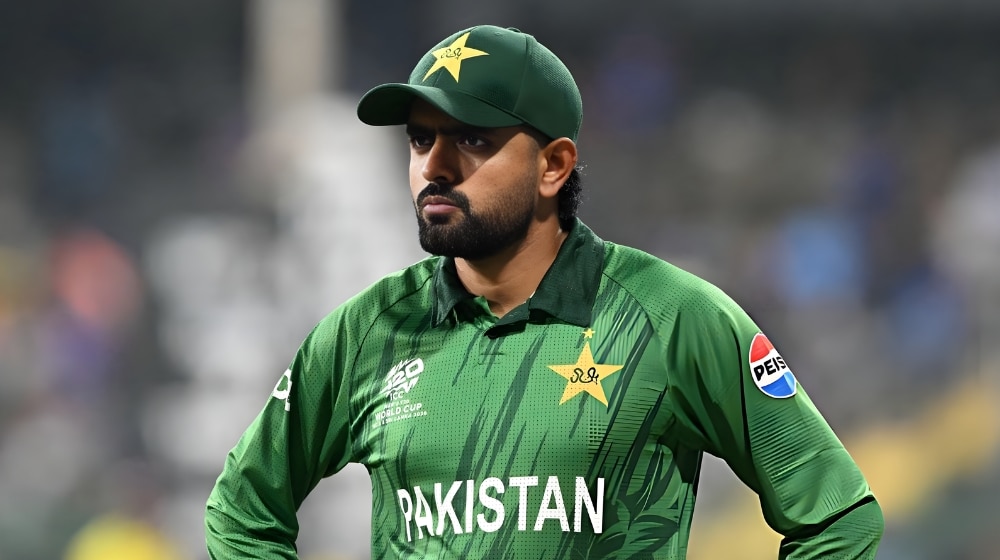
NAMIBIA: Pakistan cricket team’s head coach Mike Hesson has clarified why star batter Babar Azam was not sent to bat in a crucial match against Namibia national cricket team during the ICC Men’s T20 World Cup 2026.
Hesson revealed that the primary reason behind the move was Babar’s strike rate during the power play.
The team required aggressive intent in the early overs and explosive acceleration in the final stages a strategy that demanded a different batting combination on the day.
In this regard, as per the statistics from the tournament show that Babar scored 66 runs in three innings at a strike rate of 115.78.
However, his performance against India raised concerns when he managed just five runs off seven deliveries. Although he remained part of the squad for the Namibia fixture, he was ultimately not given an opportunity to bat.
The turning point came when Pakistan had reached 107 runs in 12.1 overs, with Sahibzada Farhan at the crease. Instead of sending Babar in next, team management opted for Khawaja Nafay and Shadab Khan, a decision that immediately drew attention and triggered questions about Babar’s role within the team structure.
Meanwhile, Hesson explained that at that specific stage of the match, Pakistan had players better suited to accelerate the scoring rate in the closing overs.
He further disclosed that following the Asia Cup 2025, Babar had been assigned a defined role focused on stabilizing innings during the middle overs rather than dominating the power play.
The head coach focused on that in a high-stakes global tournament, particularly in the power play, a strike rate below expectations does not align with the team’s strategic blueprint.