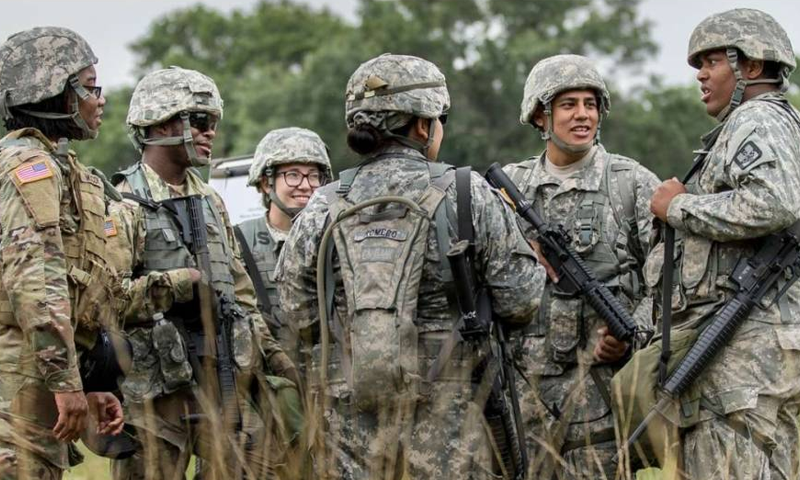
WASHINGTON: The possibility of deploying U.S. ground forces in Iran was not ruled out by President Donald Trump, who said no option would be excluded in advance.
In an interview with U.S. media, it was stated that, unlike previous administrations, no prior declaration would be made ruling out the use of ground troops. It was acknowledged that circumstances might arise where such action would not be necessary, but the possibility could not be dismissed.
Speaking later at the White House, U.S. objectives were outlined. Iran’s missile program was to be rendered ineffective. Its naval capabilities were to be degraded. Tehran was to be prevented from acquiring nuclear weapons.
Halting Iran’s support for armed groups beyond its borders was also described as a policy priority. The provision of weapons, financing and training to such groups was cited as a concern.
It was stated that Iran’s missile program had been structured to safeguard potential nuclear capability. Long-range missile capacity combined with nuclear weapons access was described as a serious threat to the Middle East and the United States.
The administration was said to be determined to prevent such developments. Support from the international community was claimed.
Diplomatic channels were said to have been pursued first. Negotiations were described as having repeatedly failed. Military action was characterized as a last opportunity to eliminate emerging threats.
Ten Iranian naval vessels were claimed destroyed. Damage to missile production capabilities was also reported. The ongoing military operation was described as progressing faster than planned. Initial estimates of four to five weeks were cited, with the capacity for extension if required.
The 2015 nuclear agreement negotiated during the administration of Barack Obama was also defended in terms of the 2018 withdrawal. The deal was described as flawed and dangerous. It was argued that, had it remained in place, Iran might have acquired nuclear weapons years earlier. The withdrawal was presented as a key policy decision of the administration.