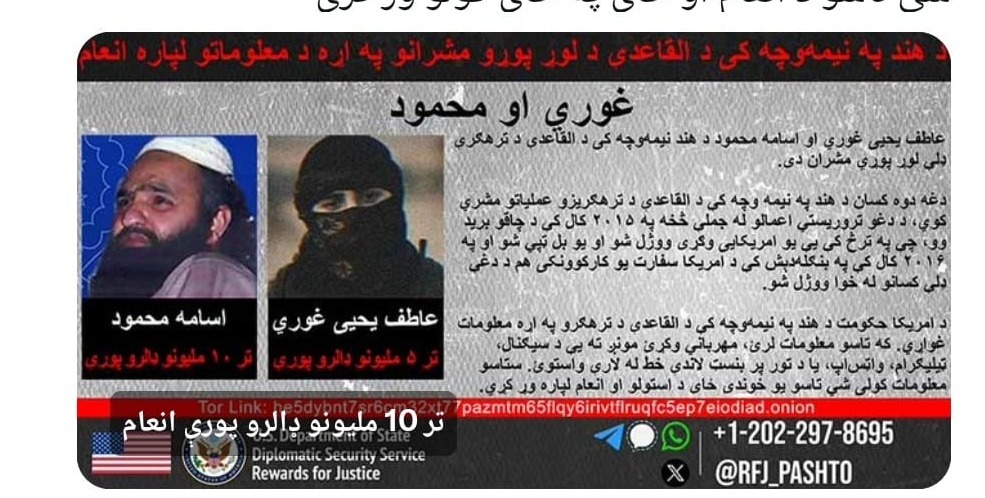
WASHINGTON: In a major move to disrupt a resurgent terrorist network, the U.S. Department of State has placed multi-million dollar bounties on the heads of Al Qaeda in the Indian Subcontinent (AQIS) leader Osama Mehmood and his deputy, Atif Yahya Ghouri. The Rewards for Justice program is offering $10 million for Mehmood and $5 million for Ghouri for information leading to their arrest.
The announcement, made on November 24, 2025, targets the senior echelon of a group that operates openly in Taliban-controlled Afghanistan. AQIS is not merely a passive presence; it is a key branch that facilitates the operations of Al Qaeda’s central leadership and coordinates jihadist activities across South and Central Asia. The group’s deep integration with the Taliban, a relationship openly acknowledged by former Al Qaeda emir Ayman al-Zawahiri, provides it with a secure base from which to operate.
Since its formation in 2014, AQIS has been involved in numerous plots, including attempts to hijack Pakistani naval vessels and attack international warships. Crucially, the group fought alongside the Taliban during its 2021 takeover of Afghanistan. Now, with the Taliban in power, Al Qaeda has regenerated its infrastructure, establishing training camps in at least 13 Afghan provinces.
Osama Mehmood, a Pakistani national also known as Abu Zar, took command of AQIS before 2019. His deputy, Atif Yahya Ghouri, is also Pakistani and ascended to his role after his predecessor was killed in a U.S. drone strike. The substantial rewards underscore the U.S. assessment that these men are pivotal to Al Qaeda’s ongoing operations and its dangerous, Taliban-enabled safe haven in Afghanistan.
Meanwhile the American and Syrian forces have concluded a coordinated multi-day operation that systematically destroyed a major network of Islamic State (ISIS) weapon storage facilities in southern Syria. The operation, which took place from November 24 to November 27, targeted 15 separate sites across the Rif Damashq province.
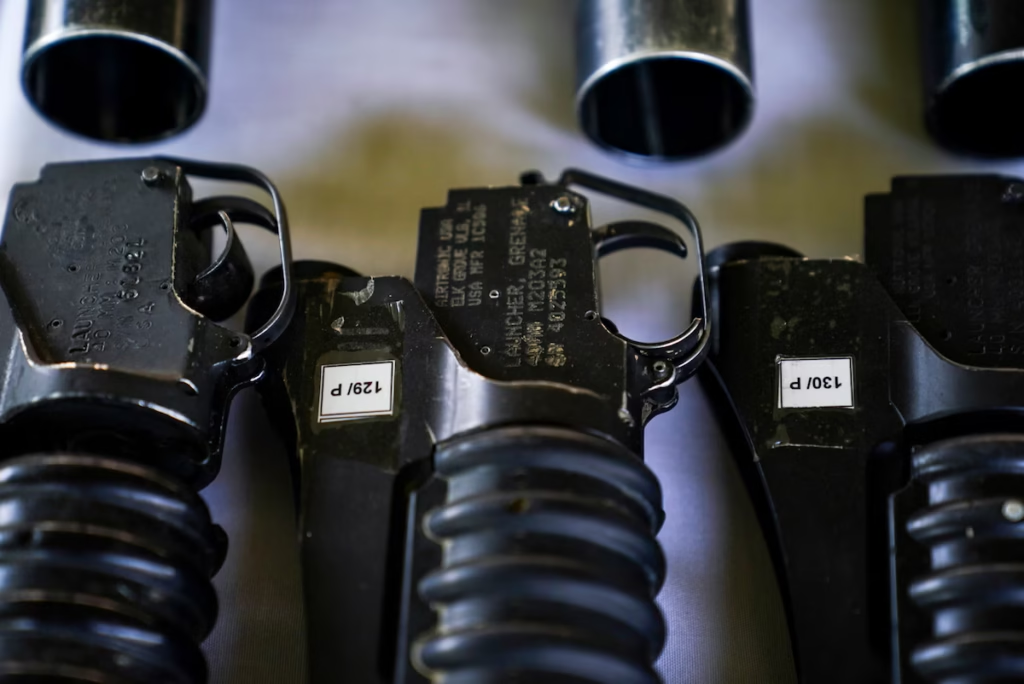
According to a statement from US Central Command (CENTCOM), the campaign employed a combination of precision airstrikes and ground detonations to eliminate the caches. The scale of the destroyed arsenal is substantial, representing a critical setback for ISIS remnants in the region. The operation successfully neutralized over 130 mortars and rockets, a wide array of small arms including multiple assault rifles and machine guns, and deadly anti-tank mines. Perhaps most critically, the strikes also destroyed materials intended for building improvised explosive devices (IEDs), a primary weapon in the terrorist group’s insurgency toolkit.