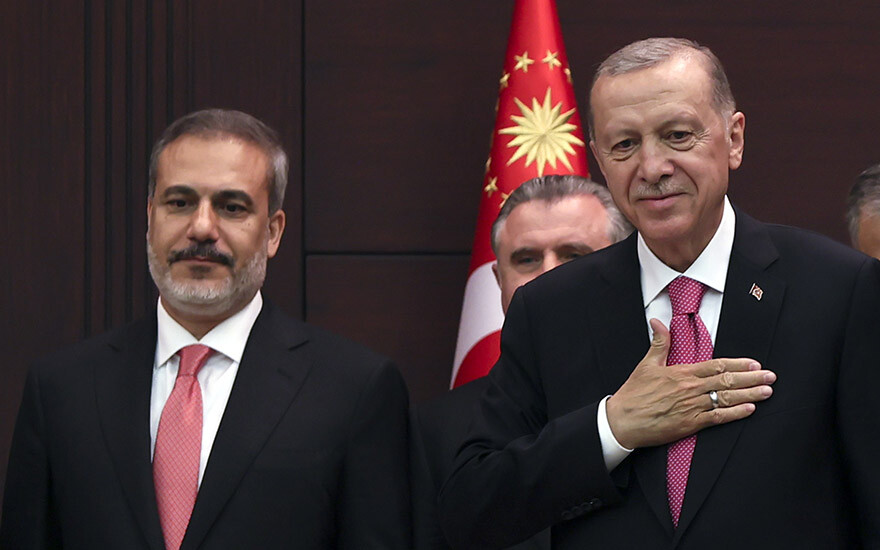
Ankara/Switzerland: Turkish Foreign Minister Hakan Fidan will represent President Recep Tayyip Erdoğan at the signing ceremony of the Board of Peace Charter in Switzerland on January 22, 2026. This was confirmed in an official statement (No: 14) issued by the Turkish Ministry of Foreign Affairs on January 21, 2026.
The Board of Peace is an international initiative, initially proposed by U.S. President Donald Trump as part of efforts to implement a ceasefire and reconstruction plan for Gaza following the Israel-Hamas conflict. Endorsed by a UN Security Council resolution in late 2025, the body aims to promote stability, restore governance, and secure lasting peace in conflict-affected areas, with an initial focus on Gaza’s post-war recovery, including reconstruction, transitional administration, and disarmament processes.
The charter outlines a structure granting significant authority to the founding chairman (Trump), including decisions on membership, meetings, and resolutions. Invitations have been extended to dozens of countries, with permanent membership potentially tied to substantial financial contributions (over $1 billion in the first year for long-term seats, though initial terms may not require payment). Founding and executive members include figures such as former UK Prime Minister Tony Blair, Jared Kushner, U.S. Secretary of State Marco Rubio, and representatives from Turkey, Qatar, Egypt, UAE, and others.
Pakistan’s Strategic Considerations
The initiative holds notable significance for Pakistan, which has received an invitation from President Trump to join the Board of Peace. Analysts and diplomatic sources highlight several factors supporting potential participation:
Pakistan’s involvement would align with its long-standing principled stance on Palestine, emphasizing UN resolutions, a two-state solution, East Jerusalem (Al-Quds Al-Sharif) as the capital of an independent Palestinian state, permanent ceasefire, Gaza reconstruction, and protection of Palestinian rights to self-determination and statehood. It would contribute to regional security and stability while demonstrating Pakistan’s active role in multilateral peace efforts amid a polarized global landscape.
Pakistan maintains strategic autonomy, avoiding bloc politics and fostering balanced relations with major powers like the United States, China, and Russia—positioning it uniquely as a bridge-builder in an uncertain world order. Its consistent foreign policy on core issues (including no recognition of Israel, unwavering support for Kashmir via UN-mandated plebiscite, and contributions to UN peacekeeping) bolsters its credibility through action rather than rhetoric.
Participation would affirm Pakistan’s growing global heft and reject perceptions of bystander status in redrawn power dynamics.