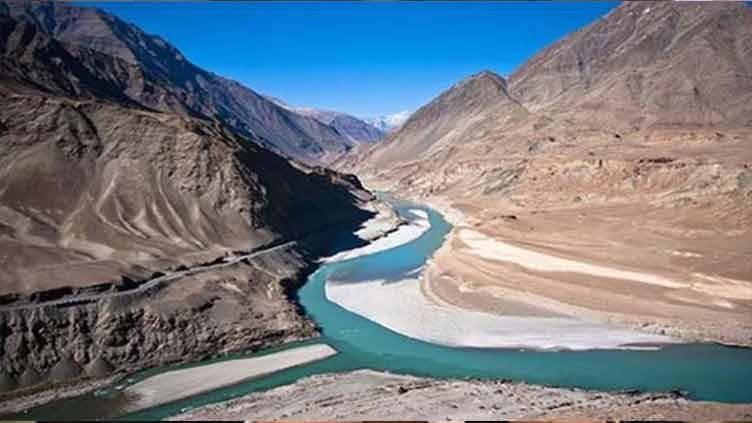
ISLAMABAD: The Indus Water Commission has turned down the rumors spread on the social media about the flow of water in the Chenab Water.
The sources of Indus Water Commission have said that the rise and fall in the water flow during this season is something usual that has a long history.
The sources have further said that the Indus Water Commission has issued no such alert officially.
The officials have further said that a few Pakistani news channels spread unnecessary sensation after running news that comes out of sources that are not relevant.
It is worth mentioning that the a few TV channesl ran a news that on account of India halting Chenab rivcer water, the flow of water has dopped down to a greater extent.
India has one sidedly suspended the Indus Water Treaty on the basis of the so called ‘ Pahalgham Attack’ months before the Behar Election.
India baselessly blamed Pakistan for the Pahalgham attack depite Pakistan’s offer to launch a credible, nutral and transparent investigation of the incident.
India not only imposed a war on Pakistan but also suspended the Indus Water Treaty turning down all the internal laws.
on 19 September 1960 in Karachi by India (Prime Minister Jawaharlal Nehru) and Pakistan (President Ayub Khan) with the World Bank as a guarantor.
Its roots lie in the 1947 partition, after which control of headworks fell in India while most canals irrigated Pakistan.
Following interim arrangements and World Bank mediation (1951–1960), the treaty allocated the eastern rivers (Ravi, Beas, Sutlej) to India and the western rivers (Indus, Jhelum, Chenab) to Pakistan, while allowing India limited, non-consumptive uses (run-of-the-river hydropower, domestic use) on western rivers under strict design constraints.
The treaty created the Permanent Indus Commission (PIC) for data sharing and cooperation and laid out dispute-resolution steps.
For decades, the treaty endured despite wars (1965, 1971, 1999) and political crises, and was often cited as one of the world’s most durable water-sharing agreements.
From the 2000s onward, strains increased due to hydropower projects in Jammu & Kashmir, notably Baglihar, Kishanganga, and Ratle, with Pakistan alleging treaty violations and India asserting compliance.
Technical disputes led to neutral expert findings and arbitration processes.
In 2022, the World Bank reactivated parallel dispute mechanisms (Neutral Expert and Court of Arbitration) to address differences over project designs and interpretation.
In 2023–2024, India sought modifications to the treaty’s dispute-resolution provisions and paused some PIC engagements, while Pakistan rejected unilateral changes.
By 2025, relations deteriorated further: India announced it was holding treaty cooperation in abeyance, reduced engagement with treaty mechanisms, and signaled plans to maximize permissible uses of Indus waters within India; Pakistan termed any unilateral suspension illegal and warned of severe consequences.
As of 2025, the treaty formally remains in force (it has no unilateral exit clause), but its implementation is under severe stress, with legal proceedings ongoing, cooperation curtailed, and the future of the IWT uncertain amid heightened political tensions.