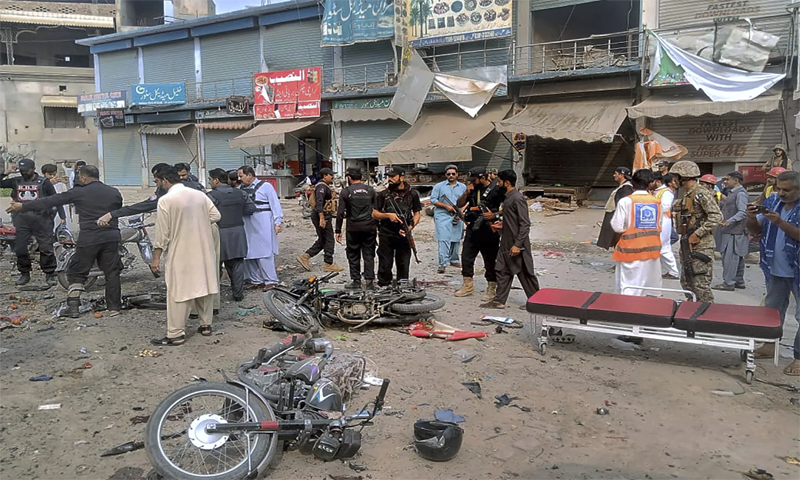
QUETTA: Security forces have made significant gains in ongoing counterterrorism operations in Balochistan province, officials said.
Available data show that 184 terrorists associated with Fitna al Hindustan, a term referred to the banned outfit the Balochistan Liberation Army (BLA), were killed during law enforcement agencies retaliatory operations across the province.
Seventeen security personnel were also martyred during the operations. The casualties included 10 police officers, six Frontier Corps soldiers, and one Levies official.
Officials also reported civilian losses. Thirty-three civilians were killed in Gwadar and the wider Makran region in the terrorist attacks.
Balochistan is Pakistan’s largest province by area. It covers 347,190 square kilometers, accounting for 44 percent of the country’s landmass. The province has a population of about 14.8 million, or 6.1 percent of Pakistan’s total population.
The provincial budget stands at 1,028 billion rupees.
Analysts say Balochistan’s unrest dates back to the 1950s. They argue that some influential tribal leaders protected smuggling networks to safeguard personal interests. These networks remain involved in drug trafficking, illegal Iranian fuel trade, and reverse smuggling linked to Afghan transit trade.
A transit permit system introduced in the 1960s to move essential goods was later exploited for smuggling, analysts say. They add that state-led projects in education, healthcare, and employment threaten these criminal interests. As a result, development initiatives face strong resistance.
Security officials describe the Balochistan Liberation Army and other banned groups as armed wings of these criminal networks.
The government’s zero-tolerance policy against smuggling has disrupted their revenue streams, officials say. Iranian diesel smuggling has dropped sharply. Volumes fell from about 20 million liters per day to nearly one million liters per day, now limited to local needs.
Security sources say militants and their facilitators follow a dual strategy. They conduct terrorist attacks to undermine the state’s authority. At the same time, they seek to shape anti-state narratives by influencing youth, writers, and liberal groups.
Officials also allege external backing. Security sources claim that India and Afghanistan provide open diplomatic and covert support to these elements.
Balochistan has a diverse population. About 40 percent are Baloch, 30 percent Pashtun, and 17 percent Brahui. Other communities include Hazaras and settlers.
Officials note that more ethnic Baloch live in southern Punjab and northern Sindh than in Balochistan itself. They say this undermines separatist claims of an “independent Balochistan.”
Also Read: Balochistan: Clearance Operation Kills Seven More, Bringing Total Toll to 184
Authorities also argue that development since 1947 contradicts narratives of long-term deprivation.