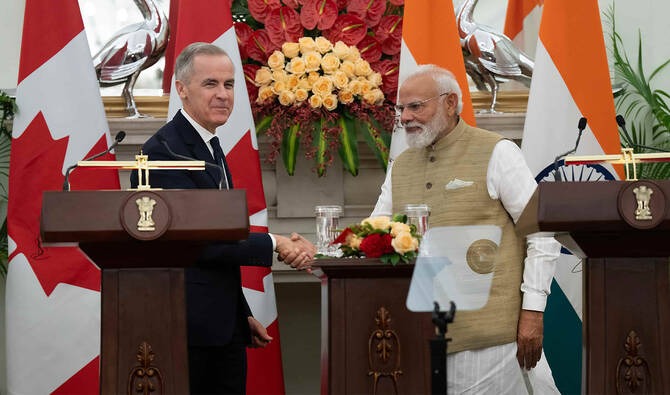
ISLAMABAD: Pakistan on Thursday expressed concern over a uranium supply and nuclear technology cooperation deal between India and Canada, warning it could boost India’s nuclear arsenal and weaken the global non-proliferation framework.
The deal covers long-term uranium supplies and potential cooperation in advanced nuclear technologies, including small modular reactors. It was announced earlier this week as part of broader efforts to strengthen energy and economic ties between the two countries.
Canada has previously supplied uranium to India under a civilian nuclear cooperation framework agreed in 2010 and implemented in 2013. Commercial supply contracts followed in subsequent years.
Foreign Office spokesperson Tahir Andrabi said assured external uranium supplies allow India to conserve domestic reserves for military use. “This enables the expansion of fissile material stockpiles, accelerates nuclear arsenal growth, and deepens strategic asymmetries in South Asia,” he said.
He added that the agreement undermines Canada’s obligations under the international non-proliferation regime.
Andrabi said the arrangement represents another country-specific exception in civilian nuclear cooperation. He noted that India’s 1974 nuclear test, carried out using plutonium from a Canadian-supplied reactor, led to the creation of the Nuclear Suppliers Group. “A state whose actions necessitated global export controls is now being granted preferential access under selective arrangements,” he said.
The spokesperson also criticized India for not placing all civilian nuclear facilities under International Atomic Energy Agency safeguards. He said binding non-proliferation commitments under the new deal remain unclear.
Also Read: Pakistan Seeks Saudi Route to Secure Oil Supplies After Hormuz Closure
“Civil nuclear cooperation must follow a non-discriminatory, criteria-based approach that applies equally to all states outside the Nuclear Non-Proliferation Treaty,” Andrabi said.
He warned that selective exceptions erode the credibility of the global non-proliferation framework and risk further destabilising regional and international peace and security.