
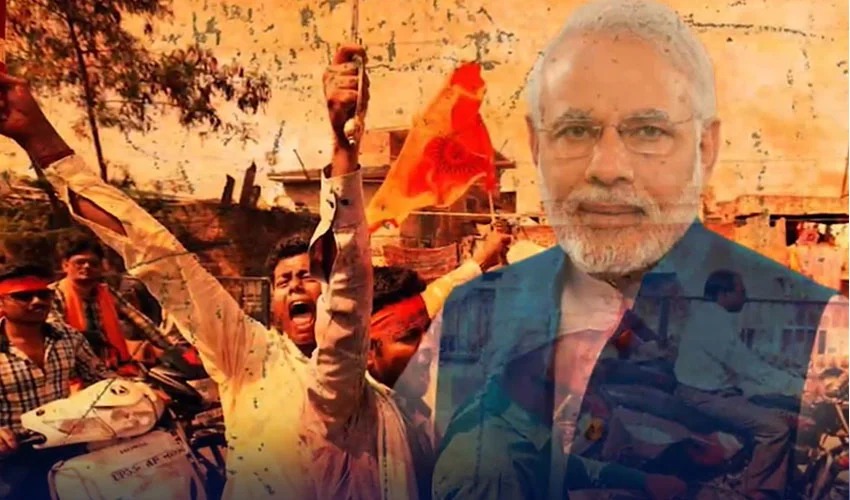
ISLAMABAD: A detailed analysis by The New York Times explores how the Hindu nationalist organization Rashtriya Swayamsevak Sangh (RSS) has gained significant influence over Indian politics as it marks its 100th anniversary.
The American newspaper’s in-depth report examines the RSS’s century-long history and its close ties to the ruling Bharatiya Janata Party (BJP), describing the latter as the political arm of the far-right group.
According to the report, the RSS was founded with inspirations drawn from fascist ideologies of the era, and since 1925, its training camps have emphasized religious ideology alongside physical and military drills. In 1948, a former RSS member assassinated Mahatma Gandhi over disagreements on minority rights.
The organization has since worked to mobilize Hindu nationalism into a powerful electoral force.
The New York Times notes that the BJP is not merely a political party but the public face of the RSS, transforming anti-Muslim sentiment and Hindu supremacist views into state policy.
Since 2014, efforts have intensified to shift India from its secular foundations toward a Hindu-majority nation-state.
With evidence spanning a century, the report argues that promoting Hindu dominance has been a core long-term strategy of the RSS.
This includes revoking the special status of Jammu and Kashmir, constructing the Ram Temple on the site of the demolished Babri Masjid, and systematically targeting religious minorities.
The article highlights how the RSS has now deeply infiltrated key Indian institutions, including education, media, judiciary, and security apparatus.
Prime Minister Narendra Modi is portrayed as functioning more as a dedicated RSS worker than solely as the nation’s leader.



