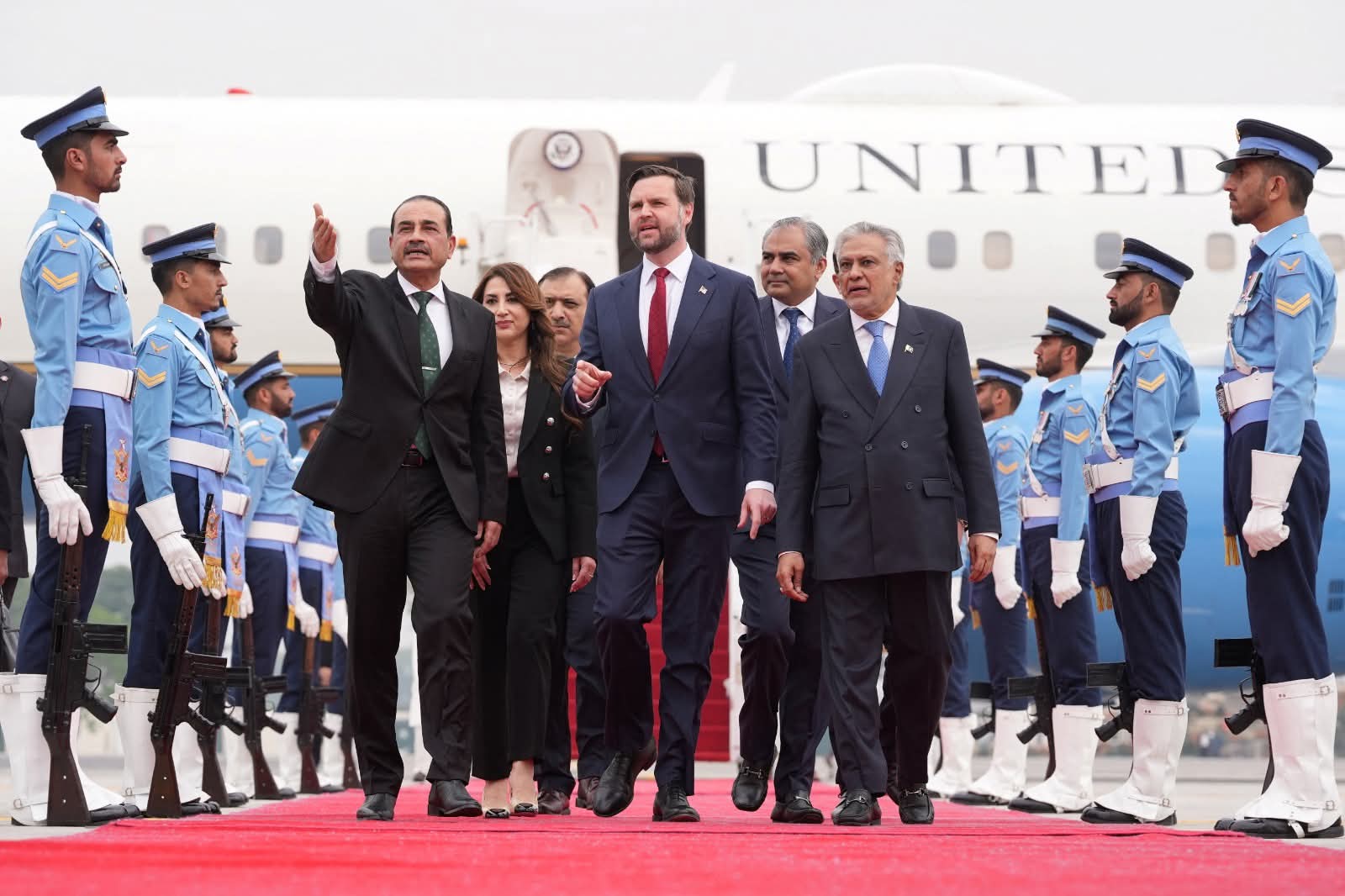
ISLAMABAD: A United States delegation led by Vice President JD Vance has arrived in Pakistan for high-stakes talks with Iran, set to begin later in the day.
The US delegation was received by Deputy Prime Minister/Foreign Minister Senator Mohammad Ishaq Dar, Chief of Defence Forces and Chief of Army Staff Field Marshal Syed Asim Munir, and Minister for Interior Syed Mohsin Raza Naqvi upon arrival, a statement of the Foreign Office read.
The Iranian delegation, headed by Parliament Speaker Mohammad Bagher Ghalibaf, arrived earlier in Islamabad. The delegation was received at the airport by Deputy Prime Minister and Foreign Minister Ishaq Dar and Chief of Army Staff Field Marshal Asim Munir.
Other members of the Iranian delegation include Foreign Minister Abbas Araghchi, Secretary of the Supreme National Security Council Ali Akbar Ahmadian, Central Bank Governor Abdolnaser Hemmati, and former IRGC commander Mohammad Bagher Zolghadr.
The talks are being held at a critical juncture. Iran has set key preconditions, including a ceasefire in Lebanon and the unfreezing of its assets, which have yet to be met.
⚡️🇵🇰🇺🇸
US Vice President JD Vance has officially arrived in Pakistan for the historic ceasefire peace talks between Iran and the United States.
Iranian delegation is already in Pakistan.
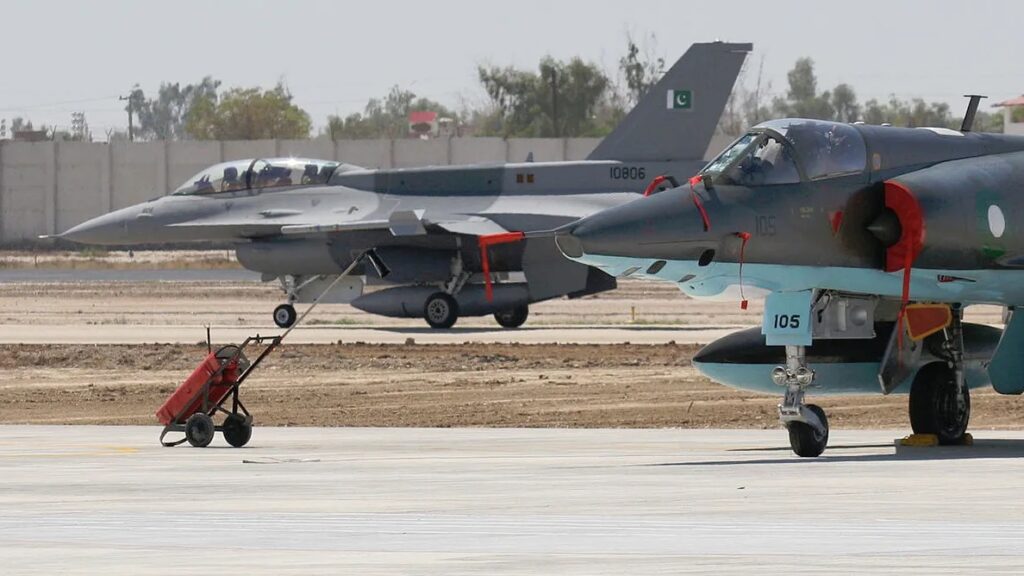
Pakistan Air Force escorted both delegations the moment they entered Pakistani airspace. pic.twitter.com/S2g3sL4vU9
— Zard si Gana (@ZardSi) April 11, 2026
Pakistan, which played a central mediating role in securing the temporary truce, has cautioned that negotiations will be complex.
“A temporary ceasefire has been announced, but a more difficult phase lies ahead — achieving a lasting ceasefire and resolving complex issues through dialogue,” Prime Minister Shehbaz Sharif said.
The American delegation to the Islamabad Talks being escorted by Pakistan Air Force F-16s: pic.twitter.com/Ofp25Ttq4T
— The STRATCOM Bureau (@OSPSF) April 11, 2026
He described the talks as a “make or break” stage and said both sides were attending at Pakistan’s invitation. He pledged that Islamabad would make every effort to ensure the success of the negotiations.
In Washington, President Donald Trump expressed optimism about the outcome, saying he was “very optimistic” about a peace deal following the Pakistan-brokered ceasefire.
He said Iran’s leadership appeared “more reasonable” in private but warned of serious consequences if no agreement is reached.
“If they don’t make a deal, it’s going to be very painful,” he said.
امریکی وفد نور خان ایئر بیس سے اسلام آباد روانہ pic.twitter.com/TG6ajevBh7
— Azmat MaliC (@TheAzmatMalik) April 11, 2026
Trump also linked the continuation of the ceasefire to the reopening of the Strait of Hormuz, a key global oil transit route that remains partially disrupted.
He said the waterway would be reopened soon “with or without” Iran’s cooperation, underscoring the high stakes of the talks.
He added that preventing Iran from acquiring nuclear weapons remains the primary objective of the negotiations.
The talks are seen as a pivotal moment in efforts to de-escalate tensions in the Middle East, placing Pakistan at the centre of global diplomacy.
🚨🇵🇰🇺🇸 American dignitaries landing in Pakistan. https://t.co/XG1mW35Fwu pic.twitter.com/1HwOdalof5
— Eagle Eye (@zarrar_11PK) April 11, 2026
In Islamabad, extraordinary security arrangements have been implemented. The Red Zone has been sealed, with key routes including D-Chowk, Constitution Avenue, and roads leading to the Serena Hotel — the expected venue — closed or heavily restricted.
Only authorised vehicles are being allowed access, while thousands of security personnel have been deployed across sensitive areas.
Pakistan has also introduced special facilitation measures for international participants, including visa-on-arrival and eased travel procedures.
As delegations gather, the talks are widely viewed as a “make or break” opportunity to turn a temporary ceasefire into a lasting agreement and to address complex disputes affecting regional stability.