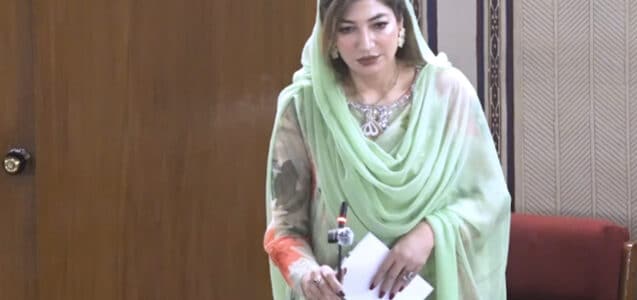
QUETTA: Farah Azeem Shah, a member of the Balochistan Assembly from the Balochistan Awam Party (BAP), has asserted that the core issue plaguing the province is economic, warning that it faces several external conspiracies.
Speaking to the media at the Balochistan Assembly on Tuesday, Shah emphasized that constitutional and legal supremacy is paramount, stating unequivocally that “no one is above the constitution and law.” She also pointed to the existence of a “strict system of accountability within the army.”
The lawmaker connected national stability to provincial development, claiming that Pakistan’s “great victory in the war of truth” has elevated the country’s global stature. She argued that harnessing this position to solve Balochistan’s economic problems must be the top priority for sustainable development.
“Balochistan is rich in natural resources,” Shah stated, “and if economic problems are solved, there will be significant improvement here.” She framed economic uplift as the key to unlocking the province’s vast potential.
Shah also paid tribute to the sacrifices of Balochistan’s martyrs, affirming that their contributions are unforgettable. “Their services will always be remembered,” she said, “because these sacrifices are the basis of the development and prosperity of the province.”
Her comments underscore the persistent economic grievances in Balochistan, where despite abundant natural resources, issues of underdevelopment, unemployment, and equitable distribution of wealth remain central to political discourse.
Meanwhile the Balochistan government has launched an initiative to bring healthcare directly to the people’s doorstep, indicating treatment accessibility as a top administrative priority.
In this regard, this extensive revitalization project is designed to alleviate the burden on residents of remote and rural districts, for whom accessing medical care often meant undertaking arduous and costly journeys.
So far, there are thousands of families can now receive primary healthcare within or near their own communities. Furthermore, the restored facilities are fully operational, staffed with medical doctors, and equipped with essential medicines and modern diagnostic equipment.