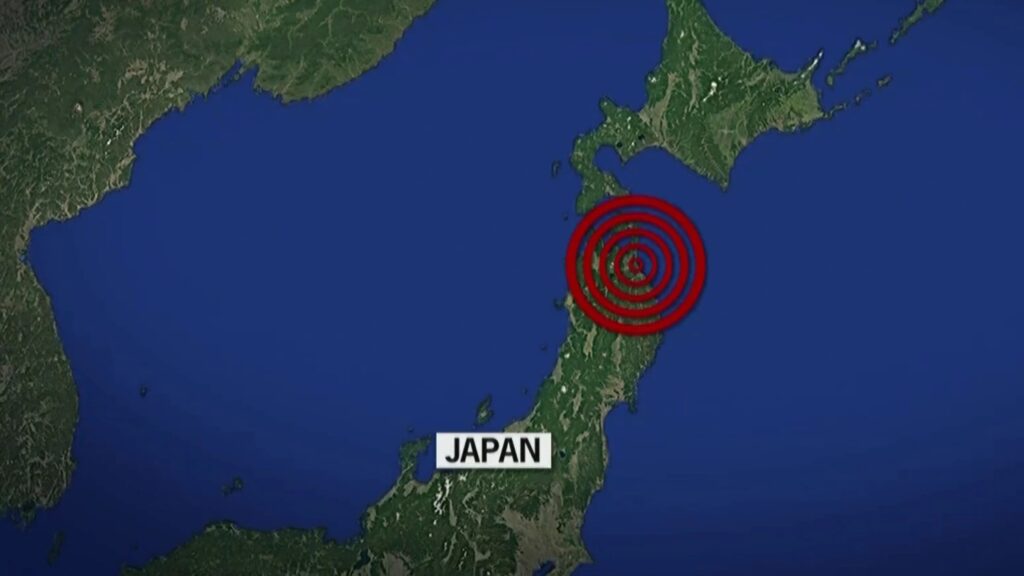
TOKYO: A massive earthquake measuring 7.6 on the Richter scale struck the northeastern regions of Japan.
According to the Japan Meteorological Agency, a tsunami warning has been issued for coastal areas in the northeast, with waves expected to reach up to 10 feet in height.
Initial tsunami waves are anticipated to hit port areas stretching from Aomori to Iwate in the northern region.
So far, no casualties or property damage have been reported in connection with the earthquake.
Meanwhile, in Indonesia’s capital Jakarta, a battery explosion at a drone manufacturing factory triggered a fire in a seven-story building.
The tragic incident resulted in the death of seven people.
Japan experiences frequent and powerful earthquakes because it lies on the meeting point of several major tectonic plates, including the Pacific, Philippine Sea, Eurasian, and North American plates.
This region is part of the Pacific Ring of Fire, an area known for intense seismic and volcanic activity.
The constant movement and collision of these plates make earthquakes a regular occurrence across the country.
Earthquakes in Japan vary in depth and strength, with shallow quakes often causing the most destruction.
Many earthquakes occur beneath the sea, raising the risk of tsunamis that can impact coastal areas within minutes.
Japan has faced several devastating quakes in its history, such as the 1923 Great Kanto earthquake, the 1995 Kobe earthquake, and the 2011 Tōhoku earthquake that triggered a massive tsunami and the Fukushima nuclear crisis.
These events have shaped the country’s approach to disaster management.
Japan has developed some of the world’s most advanced systems for earthquake preparedness.
Buildings are constructed with flexible, shock-absorbing designs that allow them to withstand intense shaking.
The country also operates a sophisticated early-warning system that alerts people within seconds of the first seismic waves, allowing trains to stop, machinery to shut down, and citizens to seek safety.
Earthquake education is a regular part of daily life, with families, schools, and workplaces maintaining emergency plans and supplies.
The Japan Meteorological Agency continuously monitors seismic activity and issues alerts when necessary.
Although predicting earthquakes with precision is impossible, constant research and monitoring help reduce risk.
Through strong infrastructure, public awareness, and advanced technology, Japan remains one of the most prepared nations in the world when facing earthquakes.