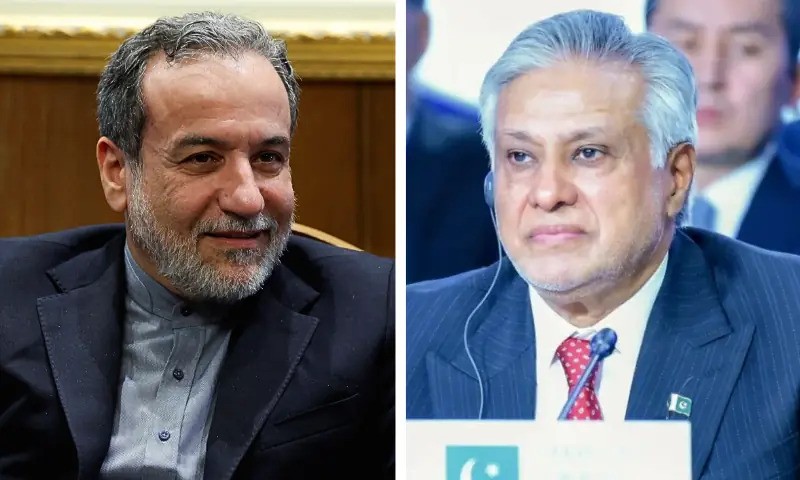
ISLAMABAD: Pakistan’s Deputy Prime Minister and Foreign Minister Ishaq Dar held a telephone conversation with Iranian Foreign Minister Abbas Araqchi, during which the two leaders discussed the changing regional situation and agreed to remain in close contact, the Foreign Office said.
According to Foreign Office Spokesperson Tahir Andrabi, Dar reiterated Pakistan’s support for all efforts aimed at reducing tensions. The deputy prime minister emphasized the importance of dialogue and diplomacy to resolve outstanding issues between the two neighboring countries.
Deputy Prime Minister / Foreign Minister Senator Mohammad Ishaq Dar @MIshaqDar50 spoke tonight with Foreign Minister Abbas Araghchi @Araghchi.
They exchanged views on the evolving regional situation.
DPM/FM reiterated Pakistan’s support for all efforts aimed at de-escalation… pic.twitter.com/PvLp2tpDM0
— Ministry of Foreign Affairs – Pakistan (@ForeignOfficePk) April 4, 2026
The spokesperson added that both leaders, in view of ongoing developments, agreed to stay in close contact.
Earlier Iran has publicly acknowledged Pakistan’s active role in ongoing regional efforts, challenging earlier narratives that portrayed Islamabad as disengaged or sidelined.
Iranian Foreign Minister Seyed Abbas Araghchi, through an official statement shared on his verified social media account, expressed appreciation for Pakistan’s contributions.
In this regard, his statements are being interpreted by analysts as a clear indication of Islamabad’s involvement in sensitive diplomatic engagements.
In this sense, the development has prompted renewed debate over the accuracy of earlier claims regarding Pakistan’s role. Analysts argue that the emerging evidence suggests a disconnect between public narratives and ongoing diplomatic realities.
Some observers believe that certain interpretations may have been influenced by incomplete information or misreading of Pakistan’s traditionally low-profile diplomatic style.
Iran’s position is being misrepresented by U.S. media.
We are deeply grateful to Pakistan for its efforts and have never refused to go to Islamabad. What we care about are the terms of a conclusive and lasting END to the illegal war that is imposed on us.
پاکستان زنده باد pic.twitter.com/AUjBQxOFyA
— Seyed Abbas Araghchi (@araghchi) April 4, 2026
Moreover, Pakistan has historically maintained a policy of discreet engagement in regional matters, focusing on mediation, stability, and de-escalation.
This approach, while less visible in public discourse, has often played a role in facilitating dialogue among regional actors.
The latest acknowledgment from Tehran reinforces the perception that Pakistan remains an active and relevant participant in regional diplomacy. It also underscores the importance of verifying claims in complex geopolitical situations where much of the activity occurs outside public view.