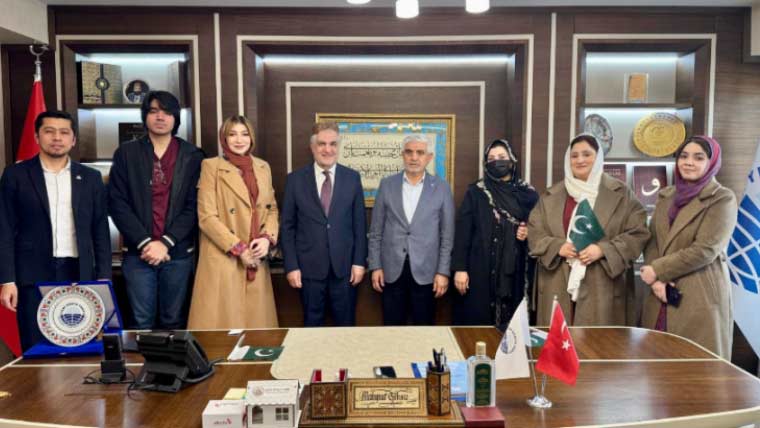
ANKARA: A delegation of women Members of the Provincial Assembly (MPAs) from Balochistan visited Türkiye (Turkey) to further strengthen bilateral ties at the parliamentary, diplomatic, economic, and people-to-people levels.
The delegation was led by Farah Azeem Shah, MPA, who is a leader of the Balochistan Awami Party (BAP) and serves as President of its Women Wing.
Other members included Salma Kakar, MPA (Awami National Party – ANP), Hadiya Nawaz, MPA (Pakistan Muslim League-Nawaz – PML-N), and Kulsoom, MPA (National Party).
During the visit, the delegation held several important meetings with Türkiye’s senior political leadership and parliamentary representatives.
Discussions focused on enhancing bilateral cooperation, youth development, education, investment opportunities, and promoting positive narratives.
The group met with the leadership of President Recep Tayyip Erdoğan’s ruling Justice and Development Party (AK Party), where topics such as the brotherly relations between Pakistan and Türkiye, parliamentary collaboration, and regional development were addressed.
They also met with Senator Dr. Mustafa Kaya, Deputy Chairman of the Saadet Party and a member of the NATO group in the Turkish Grand National Assembly.
In her remarks during the meetings, Farah Azeem Shah highlighted Balochistan’s strategic significance, abundant natural resources, and vast development potential.
She noted that initiatives like the Balochistan Sustainable Development Initiative (BSDI) are rapidly transforming the province’s developmental landscape.
She invited Turkish investment in key sectors such as mines and minerals, infrastructure, skills development for youth, and education.
Additionally, she requested the provision of scholarships for Pakistani students, particularly those from Balochistan in Turkish universities.
Turkish leaders expressed regret over the negative portrayal of Balochistan in global media, describing it as part of anti-Pakistan propaganda, while emphasizing that the ground realities are entirely positive and contrary to such narratives.
Both sides agreed to establish a joint think tank and working groups to foster policy-level cooperation, explore investment prospects, facilitate youth exchange programs, and effectively counter fake news and negative propaganda.