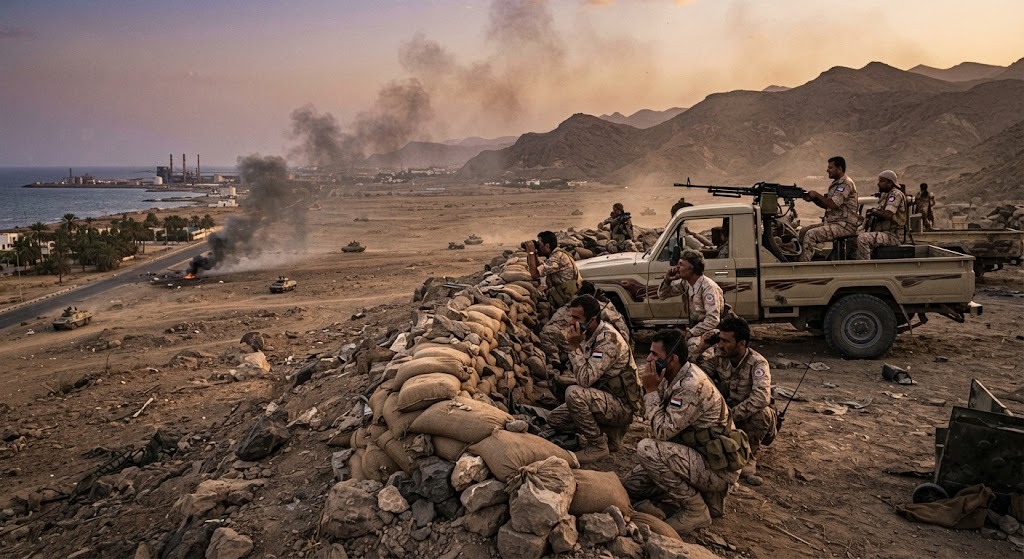

ADAN: Yemeni Forces and Houthi Clashes have raised strain in Yemen. Intense clashes erupted near the western coast of Yemen and around the city of Taiz when the Houthi movement, Ansar Allah, launched a series of heavy drone and missile attacks against government troops.
According to Arab media reports, these violent confrontations and exchanges of gunfire during the Yemeni Forces and Houthi Clashes resulted in more than 120 fatalities overall.
Government military sources stated that dozens of security personnel lost their lives in the fighting, while counter-operations inflicted heavy casualties on the Houthi fighters.
The primary objective behind the recent escalation revolves around gaining control of strategically vital coastal regions and key port cities.
According to military analysts, this wave of Yemeni Forces and Houthi Clashes intensified when Houthi rebels attempted to cut off the crucial port city of Mokha from other government-held territories and advance toward areas adjacent to the Bab al-Mandab strait, a critical maritime corridor for international trade in the Red Sea.
This bloody confrontation between the two sides has once again brought the region’s ongoing political and military crisis to a dangerous turning point.
These recent violent events along the western coast reaffirm that the conflict has no immediate military solution in sight.
Against the backdrop of the prolonged war between the Houthi movement and the Yemeni army, persistent regional tension and a severe humanitarian tragedy continue to engulf the entire country, regularly culminating in deadly outcomes like the Yemeni Forces and Houthi Clashes.
The Broader Unrest and Conflict in Yemen
The ongoing civil war and instability in Yemen represent one of the worst humanitarian crises in modern history.
The roots of this conflict trace back to 2014 when the Iran-backed Houthi movement, Ansar Allah, seized control of the capital, Sanaa, and ousted the internationally recognized government.
This prompted a Saudi-led coalition to launch a military intervention in 2015 to restore the government, effectively transforming a domestic power struggle into a protracted and devastating proxy war.
Decades of armed conflict have severely crippled Yemen’s infrastructure, displaced millions of citizens, and left the national economy in ruins.
Although international mediation efforts and periodic ceasefires have been attempted, a persistent lack of compromise between the warring factions and the strategic race for territorial dominance remain major obstacles to a lasting resolution.
ALSO READ: Yemen Confirms Military Strikes Against Houthis Over Marib Attacks
The geopolitical significance of the Red Sea coastline and the Bab al-Mandab strait has also drawn international stakes into the theater, ensuring that the instability continues to threaten global shipping lanes and regional security alike.