HANGZHOU: Prime Minister Shehbaz Sharif has stated that Pakistan is on track to match China’s pace of regional development, emphasizing a decisive shift in the country’s economic strategy toward attracting foreign expertise and investment rather than seeking loans.
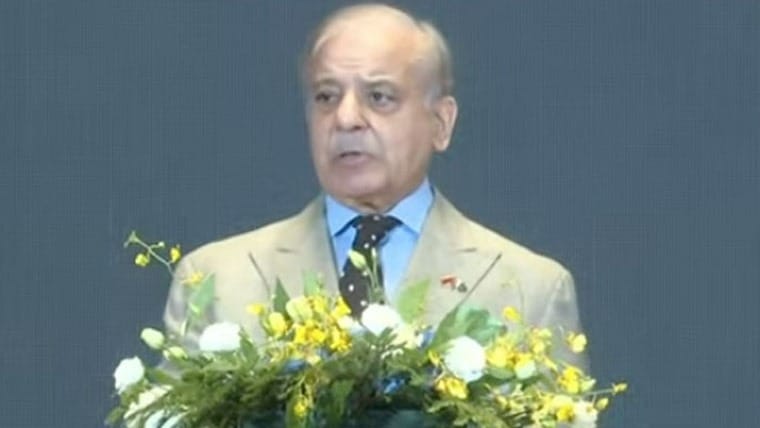
Speaking at the Pak-China Business-to-Business (B2B) Forum in Hangzhou, held to commemorate the historic 75 years of bilateral relations, the Prime Minister described the friendship between the two nations as one that now touches the skies.
He lauded Chinese President Xi Jinping’s vision for transforming China into a global economic and military powerhouse and announced that thirty percent of the recently signed Memorandums of Understanding (MoUs)—worth billions of dollars—have already been converted into formal agreements.
Prime Minister Sharif invited Chinese investors to tap into Pakistan’s vast mineral wealth and announced the establishment of a world-class Special Economic Zone spanning six thousand acres in Karachi, promising international investors a seamless one-window operation and red-carpet treatment.
He identified agriculture, information technology, economic zones, and minerals as the four pivotal sectors for bilateral cooperation, adding that the government is actively equipping Pakistani youth with global IT certifications and focusing on value addition to generate millions of small businesses in rural areas.
Echoing these sentiments at the investment conference, Deputy Prime Minister and Foreign Minister Ishaq Dar highlighted that economic diplomacy has been made the central pillar of Pakistan’s foreign policy.
Addressing representatives from five hundred Pakistani and Chinese companies, he revealed that the volume of the Pak-China B2B partnership has crossed thirteen billion dollars, backed by over three hundred finalized MoUs.
The Deputy Prime Minister noted that despite recent regional challenges, Pakistan has achieved critical macroeconomic stability over the past four years through rigorous economic reforms and industrial modernization.
He further outlined that the second phase of the China-Pakistan Economic Corridor (CPEC) will effectively serve as a “Digital Silk Road,” accelerating bilateral advancement in artificial intelligence and fiber optics.
Highlighting domestic governance milestones, he added that the federal government has successfully transitioned to a ninety-nine percent paperless environment through e-office systems and continues its push toward a cashless economy, anchored by the newly established Digital Economy Headquarters in Islamabad.