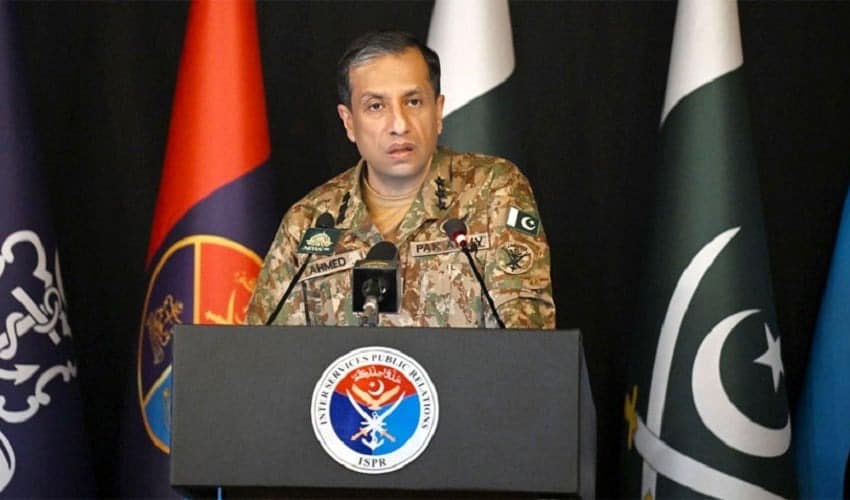
ISLAMABAD: DG ISPR Lieutenant General Ahmed Sharif Chaudhry said several key questions surrounding the Pahalgam incident remain unanswered even one year later. He said the international community, the people of Pakistan, and many in India continue to seek answers.
Addressing a press conference marking one year of “Operation Marka-e-Haq,” the military spokesperson reviewed the role of Pakistan’s armed forces, navy, and air force during the conflict and the events linked to it.
He said Indian authorities registered an FIR within minutes of the Pahalgam incident and quickly claimed the attackers came from outside the country. However, he said no credible evidence has been presented to support the allegation.
The DG ISPR questioned India’s intelligence capabilities. He said if Indian intelligence agencies were truly effective and well informed, they should have detected individuals allegedly travelling hundreds of kilometres before the attack. He asked where Indian institutions were at the time and what actions they had taken.
He said the international community still wants to know who was behind the Pahalgam incident and what motives were involved. He added that many informed voices within India are also demanding answers.
The military spokesperson said India’s information minister took international media representatives to the site the following day. However, he said India still failed to provide reliable evidence to the world.
Operation Ghazab Lil Haq Against Indian Proxies
DG ISPR Lieutenant General Ahmed Sharif Chaudhry said Indian-backed militant groups were targeting unarmed civilians through proxy networks, adding that terrorism had declined significantly after Operation Ghazab Lil Haq.
The military spokesperson said the group referred to as “Fitna al-Hindustan” had no connection with Islam or Baloch traditions and values. He strongly condemned militant violence carried out in the name of religion and said such elements were acting against the principles of Islam.
The DG ISPR alleged that India was using proxy groups to fuel terrorism inside Pakistan. He said evidence of Indian involvement in destabilising activities in Pakistan was widely known and repeatedly highlighted by Pakistani authorities.
He also claimed that Afghan territory was being used by Indian-sponsored militants to plan and launch attacks against Pakistan. He said Pakistan had consistently raised the issue with relevant authorities and at international forums.
Lieutenant General Ahmed Sharif criticised militant groups for, in his words, cooperating with hostile foreign elements while carrying out attacks inside an Islamic state. He questioned how alliances with non-Muslim hostile forces and attacks on civilians could be justified under Islam.
The military spokesperson said Pakistan’s security forces had achieved major gains against terrorism through sustained counterterrorism operations. He said the overall security situation had improved considerably following Operation Azb-ul-Haq, though efforts against militancy would continue.
He reaffirmed that Pakistan’s armed forces remained committed to eliminating terrorism and protecting the country’s stability and sovereignty.
India’s Narrative on Terrorism Exposed; DG ISPR
Ahmed Sharif Chaudhry said India’s narrative accusing Pakistan of terrorism has now been completely exposed, and during “Marka-e-Haq” the world witnessed which country acted responsibly in the region.
He said that immediately after the Pahalgam incident, an FIR was registered within minutes and claims were made that the attackers had come from outside India. However, he said no concrete evidence had been presented so far.
According to the DG ISPR, if Indian intelligence was truly effective, it should have detected in advance the alleged movement of individuals from hundreds of kilometres away. He questioned where Indian institutions were at the time and what role they were playing.
He said the international community was still asking who was behind the Pahalgam incident and what the motive was. He added that not only the people of Pakistan but also informed circles within India were seeking answers.
The DG ISPR said India had repeatedly accused Pakistan of terrorism, but after “Operation Marka-e-Haq” that narrative had lost credibility internationally. According to him, the world had witnessed which country was contributing to instability in the region.
He said Pakistan demonstrated restraint and responsibility during “Marka-e-Haq” and helped prevent tensions from escalating further. He added that Pakistan prioritised regional peace and stability throughout the confrontation.
Ahmed Sharif Chaudhry said the international community saw Pakistan acting as a responsible state by helping contain tensions, while India continued issuing provocative statements driven by political motives.
He said India had long attempted to portray itself as a “net security provider” in the region, but “Operation Haq” exposed realities before the international community.
According to the DG ISPR, if any country was sincerely working for regional stability, it was Pakistan.
He said several examples of India’s so-called professional military thinking had emerged over the past year. According to him, some statements by Indian military leaders appeared political rather than professional.
He said the Indian military leadership seemed to be transferring political narratives into military institutions, while Pakistan’s armed forces maintained a professional approach throughout the period.
According to him, no Pakistani military officer used provocative language based on political rhetoric, whereas statements by Indian politicians often created a hostile atmosphere.
He said Indian leaders repeatedly used aggressive rhetoric and provocative slogans, but Pakistan responded with restraint, professionalism and responsibility at every stage.
The DG ISPR said if India had objections or disagreements on any issue, it should address them directly and responsibly instead of making inflammatory statements.
He further stated that India faced both internal and external challenges but often attempted to shift responsibility for those issues onto others.
Ahmed Sharif Chaudhry said the treatment of Muslims, Christians and other minorities in India, including in Kashmir, was visible to the world. He added that the situation in Manipur and other regions also remained concerning.
He said the Kashmir issue remained an internationally recognised dispute under existing United Nations resolutions. According to him, despite demographic changes and legal measures by India, the dispute remained unresolved.
The DG ISPR said whenever India faced internal or external difficulties, it revived the terrorism narrative. He added that India frequently blamed others for various incidents and at times used domestic incidents for political purposes.
He said this was not a new strategy and that India had followed the same pattern for many years.
Ahmed Sharif Chaudhry further said Pakistan gained practical experience of modern multidimensional warfare during “Operation Haq” and “Bunyan-un-Marsoos.”
He said modern warfare was no longer limited to traditional battlefields. According to him, it now extended across air, land, sea, cyber, information and psychological domains.
He said the effects of such warfare were felt in cities, villages and among ordinary civilians. Modern conflict, he added, involved not only weapons but also information, narratives and psychological influence.
The DG ISPR said Pakistan faced these challenges with preparedness and an effective strategy on every front. He said Pakistan remained fully prepared before, during and after the confrontation.
Ahmed Sharif Chaudhry said Pakistan made it clear during “Operation Haq” that no compromise would be made on national defence and that the country possessed the capability to respond strongly to any aggression.
He added that Pakistan remained prepared for every challenge and would respond immediately and effectively to any hostile action.
According to the DG ISPR, the vision of Pakistan’s founder, Muhammad Ali Jinnah, remained alive today and no conspiracy or aggression against Pakistan could succeed.
He said “Operation Haq” sent a message to the world that Pakistan stood united and strong on its sovereignty, security and defence, and that this reality was increasingly being recognised internationally.