
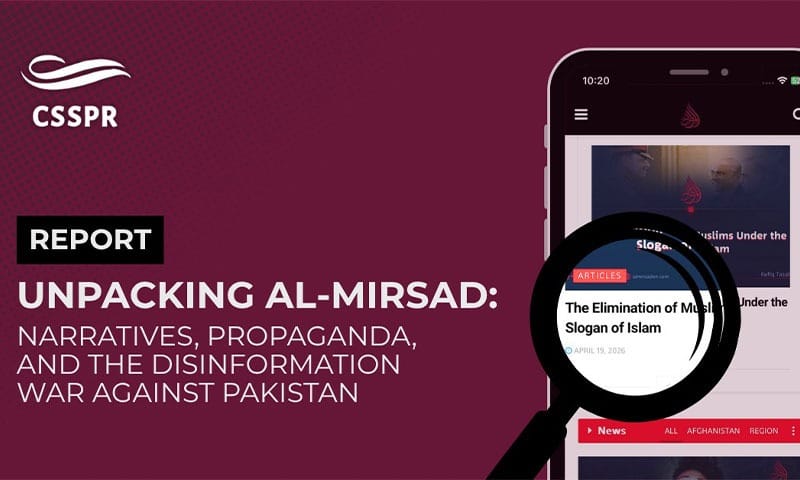
LAHORE: A detailed study by the Centre for Security, Strategy and Policy Research (CSSPR) at the University of Lahore has revealed that the Afghan media outlet “Al-Mirsad” as a structured propaganda platform linked to the Taliban’s intelligence system.
The findings released in the report say that the platform has been said to produce coordinated and modern narrative campaigns against Pakistan, aimed at undermining state institutions and weakening public trust.
Established in 2023, Al-Mirsad has been described in the report as a non-independent media outlet operating as a professional information warfare tool under centralized control linked to the Taliban leadership.
It has been stated that the platform is designed to shape ideological narratives in support of the Taliban administration while portraying Pakistan as illegitimate.
According to the CSSPR study, the outlet operates a multi-layered digital strategy. Content is produced in multiple languages, including English, Urdu, Pashto, Arabic, Dari, and Hindi.
Distribution has been carried out through platforms such as Telegram, X, WhatsApp, and YouTube. The use of advanced digital techniques, including artificial intelligence tools, has also been indicated.
The report states that religious concepts have been used as a narrative tool. It has been alleged that militant violence is framed as a religious obligation, while Pakistan’s counter-terrorism operations are portrayed as unlawful.
Al-Mirsad has also been described as a mobilization platform for militant groups, including attempts to legitimize the Tehrik-i-Taliban Pakistan (TTP) and obscure links between Taliban and TTP networks.
Psychological and emotional messaging techniques have been used to highlight ethnic divisions in Pakistan, particularly in Pashtun and Baloch regions, the study said.
Global issues such as the situation in Gaza have also been used in messaging to influence youth engagement and promote broader anti-Pakistan sentiment within a religious narrative framework.
The report further states that internal Taliban policies, including restrictions on civil liberties, have been largely ignored by the platform, while Pakistan is portrayed through allegations and unverified claims.
It was also stated that narratives have been circulated with the aim of affecting Pakistan’s regional partnerships, including relations with China.
Also Read: Afghan Firing Injures Three in South Waziristan
The CSSPR study concludes that Al-Mirsad does not function as journalism or analysis, but as a coordinated propaganda instrument combining information warfare and militant messaging aimed at distorting facts and shaping perceptions.