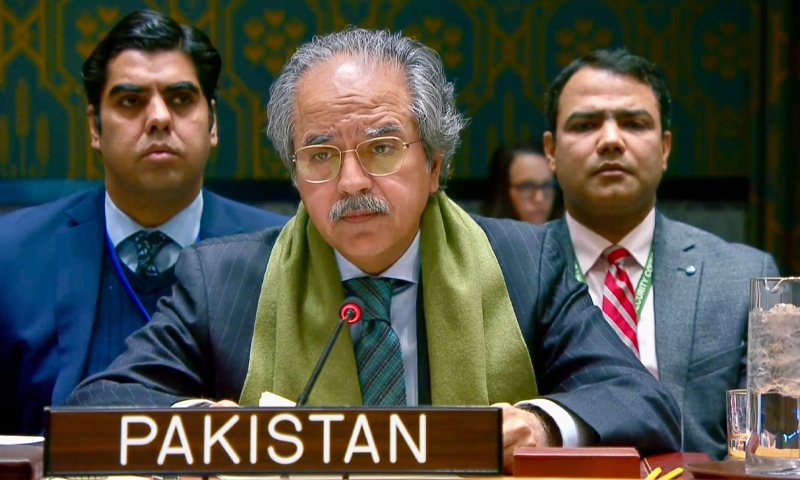
UNITED NATIONS: Pakistan told the UN Security Council that international law cannot survive on declarations alone and must be upheld through consistent conduct and credible accountability.
Speaking at a high-level open debate, Pakistan’s Permanent Representative Ambassador Asim Iftikhar Ahmad said global stability depends on law over power, principles over expediency, and justice over impunity.
The debate was titled “Reaffirming the Rule of Law: Paths to Restoring Peace, Justice and Multilateralism” and was held under Somalia’s presidency of the Council.
Ambassador Ahmad congratulated Somalia on assuming the presidency and welcomed the timely discussion. He said the meeting was part of an ongoing high-level diplomatic dialogue on the future of the United Nations, multilateralism, and international law.
He warned that the erosion of respect for international law is driving conflicts, humanitarian crises, and weakening multilateral cooperation. He said international law is meant to regulate state behavior and ensure global stability, but selective application strips it of meaning.
A peaceful and stable international order, he said, requires fair, consistent, and non-discriminatory enforcement of the law.
The Pakistani envoy expressed concern over the growing use of force over law. He said core principles of the UN Charter — sovereign equality, non-interference, territorial integrity, prohibition of force, and the right to self-determination — are under severe strain.
He warned that unilateral actions outside the UN Charter undermine collective security and weaken the credibility of multilateral institutions.
Ambassador Ahmad said Pakistan itself has suffered violations of international law. He said India carried out unprovoked military aggression against Pakistan in May, calling it a clear breach of international law and Pakistan’s sovereignty.
He said Pakistan exercised its inherent right to self-defense under Article 51 of the UN Charter in a responsible, restrained, and proportionate manner. He added that Pakistan rejected any attempt to normalize coercion or impunity.
Turning to South Asia, he said India’s illegal occupation of Jammu and Kashmir remains the root cause of regional instability. He said the occupation violates UN Security Council resolutions and denies Kashmiris their right to self-determination.
He warned that continued denial of this right has fueled serious human rights violations and threatens lasting peace in the region.
Pakistan also condemned India’s unilateral suspension of the Indus Waters Treaty. Ambassador Ahmad called it a grave violation of international law and said weaponizing water endangers millions of lives and livelihoods.
He stressed that respect for treaties is the foundation of the international legal system.
Reaffirming Pakistan’s commitment to peaceful dispute resolution, he cited Security Council Resolution 2788 adopted unanimously last July. The resolution prioritizes dialogue, mediation, and judicial settlement to resolve disputes.
The ambassador said double standards and weak enforcement have left the global system falling short of the expectations of developing countries, especially those in the Global South. Despite this, he said, these countries continue to place faith in the UN Charter and a fair international order.
He called for UN reforms based on equality, democracy, and accountability rather than power and privilege.
On Palestine, Ambassador Ahmad described the situation as a stark example of selective application of international law. He said denial of Palestinian self-determination and violations of international humanitarian law have damaged the credibility of the global system.
He said full implementation of Security Council resolutions is essential to restore the Council’s authority.
Pakistan also presented proposals to strengthen respect for international law. These included effective monitoring of Security Council resolutions, greater and systematic use of the International Court of Justice, regular institutional briefings by the UN Office of Legal Affairs, and increased reliance on ICJ advisory opinions.
Also Read: Pakistan, Myanmar Agree to Boost Consular Cooperation for Scam Victims
Ambassador Ahmad concluded by saying the rule of law is upheld through action, not rhetoric. He said Pakistan remains committed to a UN Charter-based international order where disputes are resolved peacefully, responsibilities are honored, and the United Nations serves as a true guarantor of peace, justice, and human dignity.