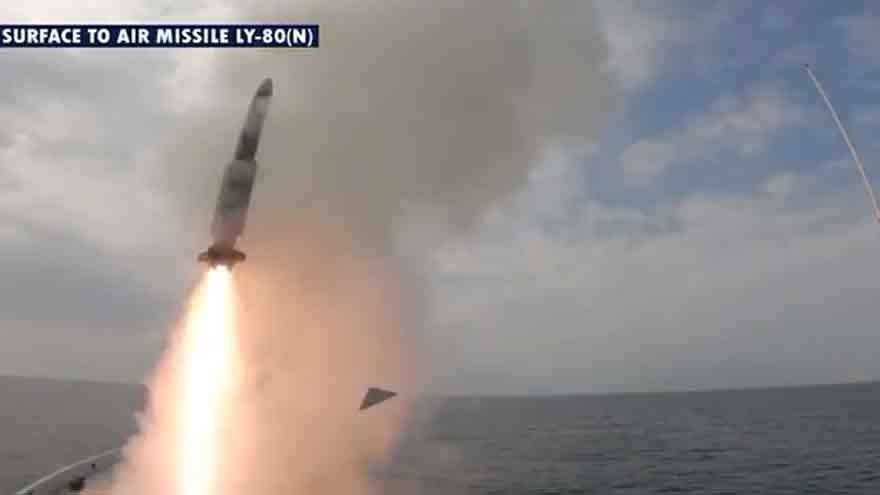
KARACHI: The Pakistan Navy conducted a comprehensive operational exercise in the North Arabian Sea, during which it successfully test-fired a surface-to-air missile.
In this regard, the Inter-Services Public Relations (ISPR) said the exercise was conducted in order to demonstrate the Pakistan Navy’s operational readiness and combat preparedness in line with the evolving nature of modern naval warfare.
The drills showcased a range of conventional and unmanned capabilities, indicating the navy’s focus on enhancing its technological and operational strengths. Furthermore, the exercise was the successful live firing of the LY-80 (N) surface-to-air missile from a vertical launching system at an extended range.
Moreover, the ISPR said the missile accurately engaged and neutralised an aerial target, validating the long-range effectiveness of the Pakistan Navy’s modern air defence systems.
The successful test demonstrated the force’s ability to counter aerial threats and protect maritime assets in a complex operational environment.
In such a scenario, the exercise also included the engagement of surface targets using loitering munition, a precision-guided system designed to enhance strike accuracy. So far, the loitering munition successfully hit and destroyed designated surface targets, mentioning the navy’s growing precision strike capabilities.
The exercise featured successful open-sea trials of an unmanned surface vessel. ISPR described the trials as a vital advancement in autonomous naval technology. The vessel demonstrated a combination of high-speed performance and mission-critical durability, validating its suitability for modern maritime operations.
In such a case, the exercise was witnessed by the Commander Pakistan Fleet, who observed the navy’s ability to effectively employ advanced systems across multiple operational domains. The Chief of Naval Staff Admiral Naveed Ashraf later commended the officers and personnel involved for their professionalism, operational competence, and successful execution of the drills.