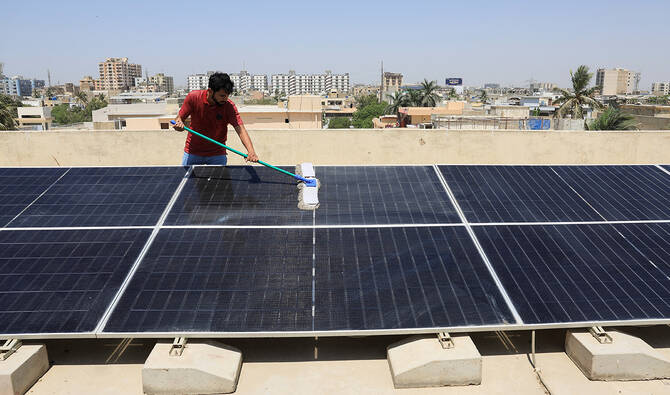
ISLAMABAD: Pakistan’s government is considering replacing its net metering policy for rooftop solar with a net billing system, an official said, as authorities seek to ease financial pressure on the power sector.
Under the proposed plan, electricity exported to the national grid by rooftop solar users would be purchased at a rate about 60 percent lower than the current price. Consumers would continue to buy electricity from the grid at prevailing commercial tariffs.
Net metering currently allows consumers to offset exported electricity directly against imported units at the same rate.
Officials say rapid growth in rooftop solar has reduced revenues for power distribution companies, while fixed capacity payments to power producers continue to rise.
Solar installations have surged in recent years as electricity prices climb and power outages become more frequent.
A senior official at the National Electric Power Regulatory Authority (NEPRA) said the proposed net billing system would apply to both existing and new solar consumers. All imported electricity would be billed at full commercial rates.
The official said NEPRA would implement the policy only after a public hearing and stakeholder consultations.
Commercial electricity tariffs range from 30 to 50 rupees per unit, depending on usage slabs, taxes, fixed charges and time-of-use rates. The official said the average energy price stands at 10 to 12 rupees per unit, while the average power purchase price is about 25 rupees.
Under the proposal posted on NEPRA’s website, new solar consumers would receive the lower energy price for exported electricity. Existing consumers would continue to receive the higher rate until their seven-year contracts expire.
Energy Minister Sardar Awais Leghari said the government would present its position at a public hearing expected next month.
He said existing contractual commitments would be honored. He added that new consumers would receive rates in line with NEPRA’s proposal.
Leghari said the policy could change only if the regulator approves revisions.
The proposal has triggered concern among consumers, energy experts and industry groups. Critics warn it could slow renewable energy adoption at a time when Pakistan faces climate risks, rising fuel imports and growing circular debt.
Pakistan Solar Association (PSA) senior vice president Hasnat Ahmad Khan said the changes would hurt consumers.
He said many households invested savings or took loans to install solar systems. He added that lower buyback rates would delay investment recovery.
Khan said industry representatives urged NEPRA to protect existing users and offer new consumers power purchase price rates for surplus electricity.
He said solar energy should receive stronger incentives, not weaker ones.
Khan warned the proposal would mainly benefit power distribution companies. He said utilities would buy cheap solar power and sell it to other users at higher tariffs.
He added that solar power deserves higher compensation because it avoids transmission losses.
Also Read: Chinese firm to build solar industrial park in Gwadar
Pakistan has pledged to increase renewable energy in its power mix. Critics say cutting rooftop solar incentives risks undermining those commitments and increasing pressure on consumers already hit by inflation and rising utility bills.