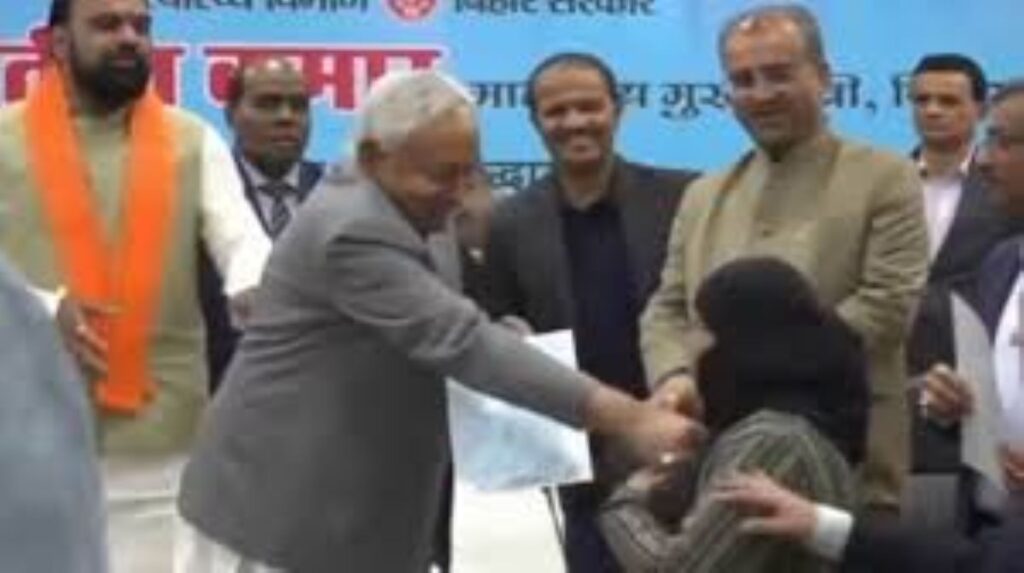
New Delhi: The political controversy has emerged in India following an incident involving Bihar Chief Minister Nitish Kumar and a Muslim woman doctor during an official appointment ceremony.
The incident occurred when Chief Minister Kumar was distributing appointment letters to newly recruited medical professionals. During the ceremony, he asked a Muslim woman doctor to remove her hijab. The moment, captured on video, circulated widely on social media, prompting public criticism and political backlash.
Furthermore, the incident as inappropriate and contrary to democratic values. The Indian National Congress, the country’s main opposition party, called for Chief Minister Kumar’s immediate resignation.
The party representatives stated that the conduct of a senior constitutional office-holder should reflect respect for personal dignity, religious freedom, and women’s rights. They characterized the alleged action as unacceptable and deeply regrettable.
In this regard, the opposition parties also voiced concern, arguing that the incident indicate broader issues regarding the treatment of women and religious minorities in India. The critics claimed that such behavior undermines constitutional guarantees of personal liberty and freedom of religion.
They further asserted that individuals in positions of authority have a responsibility to uphold these principles, particularly during official state functions. Moreover, the supporters of minority rights have emphasized that wearing the hijab is a personal and religious choice protected under Indian law.
The controversy has also renewed scrutiny of the political climate in India under the federal government led by Prime Minister Narendra Modi, where opposition parties frequently accuse authorities of fostering intolerance toward minorities.
This incident has become a focal point in the ongoing national conversation about religious freedom, gender equality, and the conduct of public officials.